

The Innovation Group Highlights Five Key Takeaways from G2E 2026
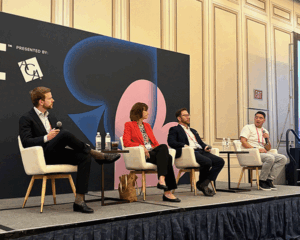
Following the 2026 Global Gaming Expo (G2E), The Innovation Group (TIG) published an article titled “Five Takeaways from G2E 2026,” outlining several major trends and discussions that emerged throughout the event. The article identified five key takeaways: prediction markets, interest rates, Las Vegas tourism, artificial intelligence, and digital gaming expansion as five areas that could significantly influence the gaming industry in the coming years.
1. Prediction Markets
Prediction markets were among the most frequently discussed topics at this year’s event. TIG noted that while legal disputes surrounding prediction markets remain unresolved, their growing popularity is creating new challenges for traditional gaming operators. The article highlighted potential implications for sportsbook licensing, tribal gaming exclusivity, market-access agreements, and state gaming tax revenue. TIG also observed that some tribal gaming operators have begun exploring partnerships with prediction market platforms, including Kalshi.
2. Interest Rates
The article also addressed the impact of interest rates on casino development and investment. According to TIG, gaming companies are taking different approaches to financing new projects, with some delaying development, others proceeding under current economic conditions, and others accelerating projects over concerns about future borrowing costs. The group emphasized the growing importance of realistic revenue projections, financial planning, and careful evaluation of investment risks.
3. Las Vegas Tourism
Las Vegas tourism was another major topic highlighted in the report. TIG pointed to changing visitation patterns, including continued strength in luxury gaming and convention business alongside weaker international tourism and reduced demand among more price-conscious visitors. The article referenced comments from Caesars Entertainment CEO Tom Reeg and MGM Resorts International CEO Bill Hornbuckle regarding economic pressures and changing customer behavior.
4. Artificial Intelligence
Artificial intelligence was also identified as an increasingly important part of casino operations. TIG highlighted applications involving marketing, surveillance, sports integrity monitoring, and operational efficiency. However, the group emphasized that successful implementation will depend heavily on operators’ ability to organize and integrate existing data systems. The article also discussed the potential for AI technology to assist with responsible gaming initiatives by identifying player behavior that may indicate gambling-related harm.
5. Digital Gaming
Finally, TIG examined developments in regulated online gaming markets. The article contrasted continued digital gaming expansion in Canada with reported regulatory changes in Brazil and limited progress toward additional iGaming legalization in the United States. TIG also identified Ontario’s Destination Niagara initiative as a potentially significant future opportunity for land-based casino development and regional tourism.
Detroit Casinos Report $103.55 Million in September RevenueDetroit’s three commercial casinos reported a combined $103.55 million in aggregate revenue for September 2026, according to the Michigan Gaming Control Board (MGCB). Table games and slots generated $102.78 million, while retail sports betting accounted for $769,771 in qualified adjusted gross receipts. September table game and slot revenue increased 4.7% compared to September 2025, but declined 5.6% from August 2026. MGM Grand Detroit led the market with $48.84 million in revenue, a 6.5% year-over-year increase. MotorCity Casino reported $32.6 million, up 12.7%, while Hollywood Casino at Greektown generated $21.34 million, an 8.8% decline. MGM held 47% of the market, followed by MotorCity at 32% and Hollywood Casino at Greektown at 21%. The casinos paid $8.3 million in state gaming taxes during September, compared to $8.0 million last year, and submitted an additional $12.7 million in wagering taxes and development agreement payments to the City of Detroit. Retail sports betting generated a total handle of $12.39 million, with $769,771 in qualified adjusted gross receipts. MotorCity led with $602,755, followed by Hollywood Casino at Greektown with $215,281, while MGM reported negative QAGR of $48,265. Overall, retail sports betting QAGR increased 3.0% year-over-year but declined 10.9% from August. The MGCB also reported that fantasy contest operators generated $657,854 in adjusted revenue during August and paid $55,260 in taxes. |